Showing posts with label Alhambra. Show all posts

Saturday, 10 December 2016

Granada

by Robert Bovington
 .
Granada is a city in the autonomous region of Andalucía, situated at the foot of the Sierra Nevada. It is one of the great cities of Spain if not the World.
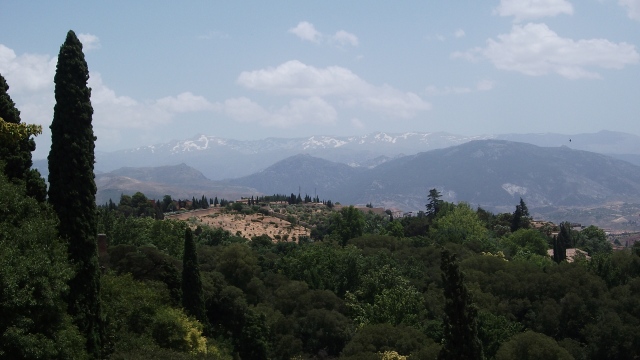
When visiting Granada it is tempting to spend all one’s time admiring the Alhambra. From afar one can admire the beauty of its red walled parapets contrasting with the snow capped Sierra Nevada whilst once inside one can absorb oneself in the sheer splendour of its fantastic palaces and its tranquil gardens. However, Granada has much more to offer the visitor.
It is a city where both Moorish and Christian history is visible in art and architecture.
Moorish Granada is exemplified by the UNESCO World Heritage Sites of the Alhambra, the Generalife and the Albaicín district whilst the Capilla Real and the Cathedral represent Christian Granada.
 .
Granada - Alhambra © Robert Bovington

 .
for more photographs of Granada click on the following link….
 .
Robert Bovington
December 2016

Wednesday, 30 November 2016

Granada Alhambra – Torre de la Vela

view from the Plaza Santa Ana © Robert Bovington
 
 .
The tower in this photo is the Torre de la Vela. The bell was used by the Arabs to announce disasters. From this privileged position a vast expanse of territory could be seen including the Vega of Granada. 
 
The tower was, therefore, critical for defence and surveillance. 
Later, the Christians used the bell to strike the hours and to announce the time that farmers could irrigate their fields. 
The Spanish flag was placed on the tower on January 2, 1492 at 3 pm.

Monday, 23 July 2012

The Alhambra Palace, Granada


Posted on  

Click to visit the original post
  • Click to visit the original post
  • Click to visit the original post
  • Click to visit the original post
  • Click to visit the original post
  • Click to visit the original post
  • Click to visit the original post
  • Click to visit the original post
  • Click to visit the original post
Within Andalucía, our neighbouring province is Granada, meaning that we only live about a 90 minute drive from Granada,  one of Spain’s most beautiful cities.  Granada offers great architecture, wonderful views of the Sierra Nevada mountains and a lively cosmopolitan atmosphere.  The city is well worth of a few days of anyone´s time.
What I want to tell you about in this post, is the amazing…
From Robert Bovington:
This is an excellent post about the Alhambra from East of Málaga's Blog


Blogs by Robert Bovington...
"Photographs of Spain"
"postcards from Spain"
"you couldn't make it up!"
"a grumpy old man in Spain"
"bits and bobs"
"Spanish Expressions"
"Spanish Art"
"Books About Spain"

Thursday, 8 December 2011

Andalucía

by Robert Bovington

map of Andalucía © Robert Bovington
Andalucía is the southernmost region of mainland Spain. It is the land of bullfighting, flamenco and gypsies. It is the land of high sierras, charming white villages and magnificent cities. It is the embodiment of Spain and yet its people think of themselves as Andalucian first and Spanish second - Andalucía became an autonomous community with its own parliament in Sevilla in 1982. The regional government - the Junta de Andalucía - administers things like taxes, health and most governmental day-to-day affairs. However, the Andalucian people have voted for independence from Spain. They already celebrate Andalucian day - on February 28 each year.

Andalucía is diverse - a country of extremes and its people live life to the full. Most British holidaymakers head for the beaches of the Costa del Sol. The more adventurous and perhaps slightly more cultured may venture further afield - perhaps to the cities of Málaga or Granada. Some might even visit the fantastic Alhambra! Most do not see the real Andalucía and miss an incredible array of cultural and ecological splendour.

There are eight provinces in Andalucía: Almería, Cádiz, Córdoba, Granada, Huelva, Jaén, Málaga and Sevilla and, within this land, the diversity of things to see is astounding. There are the green foothills of the snow-capped Sierra Nevada, the alluvial plains of the Guadalquivir River and the desert lands of Almería. There are fields of golden barley and yellow sunflowers, rolling hills of olive, almond, citrus and terraces of grape - all under an intense blue sky. Scattered across this spectacular fabric are the charming white villages that often cling precariously to the many mountain slopes in the region and the great cities like Granada, Sevilla and Córdoba.

Andalucía is the second largest region of Spain and the most densely populated yet it is seventy percent of the size of England but with only seven million people and most of these are congregated around the Costa del Sol - poor sods. The result is that there are many wide open spaces and a lot of these are conservation areas. In 2005, Spain had 1.6 million hectares of protected landscape representing 9.1% of the total area - the highest in Europe. Andalucía, however, had a whopping 18.92 per cent! One hundred and sixty three actual sites were under some sort of protection including two National Parks (Sierra Nevada and Doñana), twenty-four Natural Parks and eight Biosphere Reserves.

The areas that I have visited are delightful places to visit, walk, drive or live. The Sierra Nevada is a favourite of mine and it is the location of the highest mountain in mainland Spain, Mulhacén. It also has the charming Alpujarras spread across its southern slopes. The Doñana National Park is the largest of Spain's national parks and has three distinct ecosystems: the salt marshes, the brushwood and the salt dunes. An amazing array of fauna and flora is to be found there. The same can be said of another favourite of mine - the Parque Natural de Cabo de Gata-Níjar to give it its full title. Located a short distance from Almería, some of its species of flora are unique to the area - like the pink snapdragon antirrhinum charidemi. This park really mirrors the diversity of the region - it is volcanic in origin and comprises coastal dunes, steep cliffs, spectacular beaches, salt marshes, saltpans, arid steppe inland, dry riverbeds and a substantial marine zone. It is probably this ecological diversity that has led to the park being designated a UNESCO Biosphere reserve.

Near Ronda there are other beautiful protected areas including the Sierra de las Nieves and the Sierra de Grazalema. I discovered the former when I drove from Fuengirola to Ronda via Tolox and Coín, a longer but much more splendid drive than the more direct route via Marbella. When I visited the Sierra de Grazalema I decided that I liked it even more than the Alpujarras. It too has charming pueblos blancos - like Zahara de la Sierra, which is reckoned to be one of the most attractive of the 'White Villages of Andalucía'. Grazalema too is delightful. However there are charming white villages throughout the region - many clinging precariously to hillsides.

It is not just countryside that has been afforded protection - buildings too are on the list of protected sites. For example, the Alhambra Palace in Granada is a World Heritage site - but then the great cities of Andalucía are magnificent - Sevilla with its Cathedral and the Giralda - Córdoba and the Mezquita - Granada.


The reason for this splendour was the great influence of Muslim rule on Andalucian culture. The Moors ruled over this region for eight hundred years until the Catholic Monarchs re-conquered Granada in 1492. These Arabs and Berbers of Muslim faith had a profound effect on architecture; agriculture and the arts in this region whose name, incidentally, was derived from the Arabic name "Al Andalus".

There are other fine towns in the region: Cádiz is purportedly Europe's oldest city, Ronda is the largest of the 'White Towns' and the birthplace of bullfighting, Baeza and Ubeda have magnificent Renaissance buildings and Almería has the imposing Alcazaba - also built by the enterprising Moors.

Yes - these Arab peoples built some of the most marvellous buildings in Spain and introduced irrigation systems that are still in use today in places like the Alpujarras. It beats planting bombs and running corner shops! But I digress.

Andalucía has so many wide open spaces, delightful countryside and magnificent cities that it amazes me that most holidaymakers head for the Costa del Sol. However I hope they continue to do so - the beauty of this delightful region is enhanced by the fact that most of it is not despoiled by mass tourism. I don't want English bars in the Alpujarras thank you!


Robert Bovington

Tuesday, 18 October 2011

Alhambra


The Alhambra sits at the top of the highest wooded hill in the city of Granada. Not only that - this red-walled palace has the fairytale backdrop of the snow-capped peaks of the Sierra Nevada. Well, for most of the year the mountains are snow-capped - in August, they are somewhat er... rock-capped!


If the view from afar is spectacular, the interior of the Alhambra is simply stupendous! There is so much of artistic merit to see. However, there are four main areas to explore: the Alcazaba, the Palace of Charles V, the Casa Real or Royal Palace and the Generalife Gardens.

Lion Courtyard
The central nucleus of the Alhambra is the Nasrid Palaces. Visitors, who have already admired other parts of this magnificent fortress, are spellbound when they encounter the magnificence of these palaces. If you do not have time to explore the Alhambra in totality, you simply must allow time to visit the Nasrid Palaces! They are built around three courtyards - the Golden Room, the Myrtle Courtyard and the Lion Courtyard.


The Hall of the Ambassadors needs special mention as it is the largest and was the grand reception room. The throne of the sultan was placed opposite the entrance. It was here that Christopher Columbus received Isabel and Ferdinand's support to sail to the New World. 

The delightful Generalife garden not only has an avenue of cypress trees, terraced gardens, clipped hedges and grottos, but also fountains and a long water channel (acequia) with water jets surrounded by all manner of plants and flowers. It is a delightful place. No wonder composer Manuel de Falla wrote a piece of music about it!


Robert Bovington

Saturday, 21 May 2011

Issuu - robert-bovington's Profile

Issuu - robert-bovington's Profile

some of my free e-booklets on Issuu...


Córdoba

Córdoba

Travel writer, Robert Bovington, visits ...
Views: 28
The Alhambra

The Alhambra

Travel writer, Robert Bovington, visits ...
Views: 42
Parque Natural Cabo de Gata-Níjar

Parque Natural ...

Travel writer, Robert Bovington, explore...
Views: 27
ALCAZABA ALMERÍA

ALCAZABA ALMERÍ...

Travel writer, Robert Bovington, explore...
Views: 90
My Musical Journey

My Musical Jour...

Travel writer, Robert Bovington, writes ...
Views: 4
SPANISH FOOD & DRINK

SPANISH FOOD & ...

Travel writer, Robert Bovington, writes ...
Views: 23
Spanish Music

Spanish Music

Travel writer, Robert Bovington, explore...
Views: 8
Spanish Fiestas

Spanish Fiestas

Travel writer, Robert Bovington, investi...
Views: 13
A short drive in the Alpujarras

A short drive i...

Travel writer, Robert Bovington, explore...
Views: 5
Las Alpujarras

Las Alpujarras

El escritor Inglés, Robert Bovington, ac...
Views: 53
The Alpujarras

The Alpujarras

Robert Bovington, the author of "Spanish...
Views: 690
Roquetas y la Costa de Almería

Roquetas y la C...

El escritor Inglés, Robert Bovington, of...
Views: 28