Showing posts with label UNESCO. Show all posts

Wednesday, 7 December 2016

Elche - a garden city in Spain

by Robert Bovington
.
Basilica de Santa María © Robert Bovington

.
The Moors formally laid out the ‘Palmeral of Elche’ in the 10th century. They installed elaborate irrigation systems and these are still functioning today as are the agricultural practices developed by these enterprising people. Elche is a World Heritage site because the palm forest is so impressive and important. 
.
Elche has a number of historic monuments and one in particular is worth a visit – the ‘Basilica of Santa María’, a spectacular building with a bell tower and an imposing blue dome. The present Basilica is the fourth religious building occupying the same site. It was the site of a Muslim mosque when Jaime I, King of Aragón, conquered the town in 1265. The present building was started in 1672 and finished in 1783. 
.
A visit to the bell tower is worth the effort. From the top, panoramic views of the city can be enjoyed – in particular, the groves of palm trees. 
.
On the different landings of the tower information is displayed about the building of the Basilica, its architectural styles and its importance in regards to Elche’s other claim to fame – the ‘Misteri’ or ‘Festa d’Elx’ – a medieval sacred play. This ‘Passion play’ is acted out in the Basilica every year on the 14th and 15th of August. It is listed as ‘World Heritage’ making Elche one of the few places in the World to have two ‘UNESCO World Heritage’ awards.
.

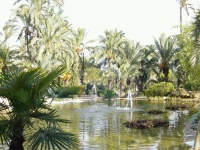
The ‘Huerto del Cura’ – the Priests Garden. It is known as ‘The Jewel of the Palm Park’ and rightly so – it is a calm relaxing place – a delightful garden of palm trees, tropical plants and cacti. It even has a pond with ducks!
.
Imperial Palm
.

The tree got its name following the visit of the Empress Elisabeth of Austria in 1894. The spectacular tree clearly impressed her. She commented to the proprietor “…the date palm has the power and strength of an empire”. The Empress was just one of many prominent visitors to the ‘Palmeral’ of Elche.
.

.
I like the cacti garden – La Rocalla has many types of cactus ranging from small spherical specimens to tall pipe-shaped ones that almost matched the palm trees for height.
.
.
.
I would recommend anyone who visits the Costa Blanca to pay a visit to Elche and to the ‘Huerto del Cura’ in particular. Magic!


Tuesday, 27 March 2012

Ávila

Even though Ávila is 3,715 feet above sea level, it is situated on a plateau that is surrounded by even loftier mountains. It is a good place to visit but not to live because, whilst the city is rather spectacular and is a notable tourist centre, it has long cold winters and short summers. The surrounding neighbourhood is not too attractive either. It is an arid, treeless plain strewn with immense grey boulders, which, I suppose, came in useful when the walls of the city were built.
Ávila
photo: Robert Bovington

Ávila is old. It is one of the oldest of all the cities in Castilla y León. Celtic Iberians, Romans, Muslims and Christians have all left their mark on this fine city.

Las Murallas - the walls - are magnificent and encompass the whole of ancient Ávila. Building started at the end of 11th century and they are 2.5 kilometres long, 14 metres high and around 3 metres thick. They are still in pretty good nick. Alfonso VI ordered their construction after his conquest of Avila in 1090. Moorish prisoners were allegedly employed to build the wall. I don't suppose they were paid though! There are eighty-eight towers and nine gates that include the imposing Puerta del Alcázar and the Puerta de Rastro. Visitors can walk along the walls between these two points. The walls are beautifully illuminated at night.

Las Murallas de Ávila
photo: Robert Bovington
The modern part of the city lies outside the walls. Within the old city are many fine buildings including churches and the 12th-century Gothic cathedral.

Ávila Cathedral was planned as a cathedral-fortress - its apse is actually part of one of the turrets of the city walls. Construction started in 1095 shortly after the Reconquest. The earliest parts were in the Romanesque style and built like a fortress with battlements and sentry walks incorporated into the structure. Most of the cathedral was built between the 12th and 14th centuries and the building is, therefore, a mix of Romanesque and Gothic. It is credited with having introduced Spain to Gothic architecture.

Ávila Cathedral  (photo: public domain - Pizicato Elena)


Ávila Cathedral north entrance photo: public domain - Manuel de Corselas


There are quite a few religious buildings in Ávila but, then, there have been a number of religious residents. These include the 4th-century theologian Priscillian who was the first Christian to be executed for heresy and the notorious Friar Tomás Torquemada who was Spain's first Grand Inquisitor and the zealous leader of the witch-hunts of the 15th century. Another resident was San Juan de la Santa Cruz who was a reformer of the Carmelite Order. The city's most famous resident, however, is St. Teresa of Ávila.
St. Teresa of Ávila

She was a major figure of the Catholic Reformation. A prominent Spanish mystic, writer and monastic reformer, she was known for her ecstatic visions and continual life of prayer. Her most famous work was her autobiography, "The Way of Perfectio" which was written from her personal experiences. St. Teresa has left Ávila with a legacy - not only the memory of her Carmelite reforms and her writings but a reminder of her can be found in the Convento de Santa Teresa, which was built in 1636 over her birthplace. Another monument to her name is the Monastery of La Encarnacion where St. Teresa lived for thirty years.

Tomás Luis de Victoria
Another famous person, born in Ávila was Spanish composer Victoria. Tomás Luis de Victoria, to give him his full name. Victoria wrote only religious music and his works included the 'Officium Hebdonadae' (1585), lots of motets and masses and 'Officium Defunctorum', the Requiem Mass that he composed for the funeral of Empress María in 1603. Victoria is generally regarded as one of the greatest composers of the 16th century.

Another religious monument is the Basílica de San Vicente, which was built in the 12th century. It stands on the alleged site of the 4C martyrdom of St Vincent. Within the church is the martyr's tomb, which has been sculpted with all the gory detail of the saint's torture and execution.

Basílica de San Vicente interior

There are a number of Romanesque churches in Ávila but the 16th-century Iglesia de San Juan Bautista is worth a mention because it was declared a National Monument in 1983. The church contains the baptismal font in which Santa Teresa was baptised. Another National monument is the Convento de San José. Francisco de Mora built it in the beginning of the 17th century - or, at least, he was the architect. It became the model for the rest of the temples that would be later constructed for the Order of the Carmelites. The convent houses the Santa Teresa Museum of the Discalced Carmelites. 

Ávila is not just about churches. There are a number of palaces and houses of noble ancestry including  the Palace of los Deanes. Originally built to house the members of the clergy, it now houses the Provincial Museum.

Palace of Los Deanes
photo: public domain

Because the city is so rich in architecture it has become a UNESCO World Heritage site.

Some more photos of Ávila...

Basílica de San Vicente

old picture of  the Plaza del Alcazar

Ávila - a walk along the walls
photo: public domain (Robert Wiblin)

Ávila - Universidad de Católica
photo: Robert Bovington
Ávila photo: Robert Bovington


more blogs by Robert Bovington...
"Photographs of Spain"
"postcards from Spain"
"you couldn't make it up!"
"a grumpy old man in Spain"
"bits and bobs"
"Spanish Expressions"
"Spanish Art"
"Books About Spain"

Monday, 26 March 2012

Segovia - the city

Segovia is the capital of the province of the same name in the autonomous community of Castilla y León. It is one of those delightful Spanish cities that have been awarded World Heritage status by UNESCO. The city is best known for its Aqueduct but its castle is quite splendid and the old town has many treasures including the Cathedral and a number of churches built in the Romanesque style. 

Segovia
There is also the Alcazar. If you visit this enchanting fortress, you might well think it looks familiar - particularly if you have visited a famous American holiday destination - the Alcazar in Segovia was allegedly the inspiration for Walt Disney's Sleeping Beauty Castle! The castle has another link with America - it was here that Queen Isabella gave Columbus financial backing for his trip to discover the New World. The castle sits high on a ledge overlooking the city. The Moors had originally built it in the 12th century and it became a favourite residence of the kings of Castile. The Catholic Isabella was proclaimed Queen of Castile here in 1474. Over the centuries, the castle was enlarged and embellished - the 'Disney-like' conical spires were added during the reign of King Philip II in the 16th century. Today, it is a museum and, if you get bored of looking at medieval weapons and armour, you could climb to the top of a tower. The 152 steps are worth climbing for the views!

Alcazar Segovia
Romantics may prefer the castle but the Aquaduct is probably the most famous monument in Segovia. Known locally as El Puente, it stands at the entrance to the historic section of the city and is a masterpiece of Roman engineering. It was built at the end of the 1st century AD and, nearly 2000 years later, it is still well preserved despite the fact that no mortar was used - the granite blocks are held together by nothing other than their own weight! The aquaduct is colossal - 20,400 granite blocks were used to build the main part of the structure, which has 166 arches. 

Aqueduct Segovia
The aqueduct may be the symbol of Segovia but the Cathedral is probably the most important building in the city. It was begun in 1525, during the reign of Carlos V and is widely considered to be Europe's last great Gothic cathedral. 

Cathedral Segovia
There are a number of important religious buildings in the city and many are Romanesque - in fact, Segovia has one of the largest concentrations of Romanesque churches in all of Europe, most dating back to the 11th century. The more notable ones are those of San Lorenzo, San Martín, San Millán, La Trinidad and San Esteban. All of the aforementioned churches and many more besides are within the old city walls. One church situated outside of the old town that is worthy of mention is the Church of Vera Cruz. Founded by the Knights Templar it is unusual in that it is dodecahedral - the building has twelve faces making it appear almost circular!

some churches in Segovia

There are many other fine monuments in Segovia including important medieval and Renaissance buildings, such as the 15th-century Corn exchange and the 14th-century Tower of los Lozoya. There are magisterial houses and beautiful palaces befitting a royal city.

NB. all of the above images have been declared public domain - special thanks to Zarateman who donated a number of the images including the churches.


more blogs by Robert Bovington...
"Photographs of Spain"
"postcards from Spain"
"you couldn't make it up!"
"a grumpy old man in Spain"
"bits and bobs"
"Spanish Expressions"
"Spanish Art"
"Books About Spain"

Friday, 11 November 2011

Ávila


Ávila by Robert Bovington


Ávila is the highest city in Spain. It has also got a short name - I am only joking - its correct title is Ávila de los Caballeros.
Even though it is 3,715 feet above sea level, it is situated on a plateau that is surrounded by even loftier mountains. It is a good place to visit but not to live because, whilst the city is rather spectacular and is a notable tourist centre, it has long cold winters and short summers. The surrounding neighbourhood is not too attractive either. It is an arid, treeless plain strewn with immense grey boulders, which, I suppose, came in useful when the walls of the city were built.

Las Murallas

Las Murallas - the walls - are magnificent and encompass the whole of ancient Ávila. They were built in the 12th century and their total length is 8,202 feet. The modern part of the city lies outside the walls. Within the old city are many fine buildings including churches, the Gothic cathedral and an old Moorish castle. It also has many elegant mansions, some of which were built into the walls.
There are many religious buildings but two worth mentioning are the Monastery of La Encarnacion where St. Teresa lived for thirty years and the Convent of Santa Teresa which was built in the 17th century on the plot where the Carmelite reformer was born. Another famous resident was Don Juan, the only son of Ferdinand and Isabella. His tomb is contained in the Convent of Santo Tomás.
Because the city is so rich in architecture it has become a UNESCO World Heritage site.
Ávila is also the capital of the province of the same name, which is located in the autonomous community of Castile-Leon in central Spain.
The province has an area of 3,107 square miles but the city of Ávila is probably the only reason for visiting. The rearing of Merino sheep is the principal occupation. There is not a lot else - certainly not a lot of ibex. This wild goat was facing extinction until an ibex sanctuary was set up in 1905.

Thursday, 26 May 2011

CÓRDOBA


by Robert Bovington

Córdoba was once the most important and richest city in the western world. It’s pretty good now as I recently discovered when I visited this beautiful city. It is one of the great cities of Spain. Along with Granada and Sevilla it is one of the classical cities of Andalucía that are famous for their spectacular architecture.

Córdoba was once the centre of the medieval Caliphate of Córdoba and capital of the western Islamic Empire. It reached its peak in the 10th century when it rivalled Baghdad and Constantinople as one of the great cities of the World. Its greatest surviving monument to the city's magnificent past is its Grand Mosque - the Mezquita.

Córdoba - Calle Torrijos


Mezquita-Catedral de Córdoba
Córdoba Mezquita
Work on the mosque actually started in 786 when it was built on the site of an old Visigothic church. However, it was enlarged three times before reaching its present size in 987 when it became the largest sacred building in the Islamic world.
Córdoba Mezquita - a ceiling in the Cathedral
And big it most certainly is - so massive that a Gothic cathedral was built inside the mosque - and a number of chapels!


Following the Christian Reconquest of Córdoba in 1236, the mosque was consecrated as a Christian cathedral. During the 14th century, the Villaviciosa Chapel and the Capilla Real were built and then in 1523, work on the cathedral started with the building of a huge nave inside the mosque.
The interior of the mosque is spectacular - a forest of pillars and arches. 856 of the granite, jasper and marble columns remain - some were removed to make way for the Christian parts of the building. Horseshoe-shaped arches consisting of alternating red brick and white stone were placed above the lower pillars, which has given the Mezquita its distinctive character.

Córdoba Mezquita Sepulchre of Cardinal Salazar in Chapel of Santa Theresa


Of course, there is much more to this magnificent building than pillars and arches! The Mihrab is particularly magnificent with its intricately carved marble ceiling and exquisitely decorated chambers with their Byzantine mosaics. All this ornamentation is in great contrast to the worn flagstones - an indication that many Muslims prayed here.

The Villaviciosa and Capilla Real chapels are both quite splendid and are good examples of Mudéjar architecture.
There used to be many entrances into the mosque but nowadays, the only one open to the public is the Puerta del Perdón.
Córdoba - Mezquita - Torre del Alminar

No self-respecting mosque should be without a patio where prospective worshippers can perform their ritual ablutions. The Patio de los Naranjos was used for this purpose. Visitors still pass through this delightful courtyard with its orange trees and fountains on their way into the Mezquita.

The minaret of the mosque is no longer visible. It is enveloped in a Baroque bell tower - the Torre del Alminar.
Córdoba Mezquita - part of the choir
Finally, there is the Cathedral. Charles V later regretted the decision to build it within the Mezquita and many people since have agreed that its construction has devalued the mosque's simple beauty. I disagree. In my humble opinion, the Christian elements blend harmoniously with the architecture of the mosque. Certainly, the Cathedral has many impressive features, particularly the choir with its Baroque mahogany choir stalls that were carved by Pedro Duque Correjo in the 18th century.

Anything this special ought to be afforded special protection and it is - UNESCO has declared the Mezquita a World Heritage site.

The sheer grandeur of the Mezquita reflected Córdoba's importance during the 8th to 11th centuries, when it was one of the world's largest and most cultured cities as well as being the capital of the Caliphate of Córdoba - an empire that incorporated a large chunk of the Iberian Peninsula as well as North Africa.

La Judería
Córdoba - Jewish Quarter
Today, Córdoba is a beautiful city and the old quarter contains many impressive monuments to its historic splendour. Close to the Mezquita, the Judería or Jewish Quarter consists of narrow alleyways, brilliantly whitewashed and splendidly decorated with flowerpots. Other important buildings include the Episcopal Palace, various churches and museums - the Museo de Bellas Artes is the main art museum in the city.

The Alcázar de los Reyes Cristianos
Córdoba - Alcázar Gardens
The Alcázar de los Reyes Cristianos is a fortified palace that was built by Alfonso XI in 1328. It was the headquarters of the Spanish Inquisition but today, it is a tranquil oasis with gardens and fountains.

Córdoba - Plaza Tendillas
Modern Córdoba
So, Córdoba has a wealth of historical buildings – all beautifully preserved but it is also a city where past and modernity blend. Plaza de las Tendillas, in particular, is a pleasant modern square adjacent to a shopping and commercial area that seamlessly merges into the old narrow streets of the Juderia. It is also only a few minutes walk to the Paseo de la Victoria that, in turn, is a pleasant promenade of greenery leading towards the old city walls.
Córdoba - Paseo de la Victoria

Wednesday, 25 May 2011

ÁVILA

by Robert Bovington

Ávila is the highest city in Spain.It is 3,715 feet above sea level and is situated on a plateau that is surrounded by even loftier mountains. It is a good place to visit but not to live because, whilst the city is rather spectacular and is a notable tourist centre, it has long cold winters and short summers. The surrounding neighbourhood is not too attractive either. It is an arid, treeless plain strewn with immense grey boulders, which, I suppose, came in useful when the walls of the city were built.

Las Murallas de Ávila
(Robert Bovington)
Ávila is old. It is one of the oldest of all the cities in Castilla y León. Celtic Iberians, Romans, Muslims and Christians have all left their mark on this fine city.

Las Murallas - the walls - are magnificent and encompass the whole of ancient Ávila. Building started at the end of 11th century and they are 2.5 kilometres long, 14 metres high and around 3 metres thick. They are still in pretty good nick. Alfonso VI ordered their construction after his conquest of Avila in 1090. Moorish prisoners were allegedly employed to build the wall. I don't suppose they were paid though! There are eighty-eight towers and nine gates that include the imposing Puerta del Alcázar and the Puerta de Rastro. Visitors can walk along the walls between these two points. The walls are beautifully illuminated at night.

The modern part of the city lies outside the walls. Within the old city are many fine buildings including churches and the 12th-century Gothic cathedral. Ávila Cathedral was planned as a cathedral-fortress - its apse is actually part of one of the turrets of the city walls. Construction started in 1095 shortly after the Reconquest. The earliest parts were in the Romanesque style and built like a fortress with battlements and sentry walks incorporated into the structure. Most of the cathedral was built between the 12th and 14th centuries and the building is, therefore, a mix of Romanesque and Gothic. It is credited with having introduced Spain to Gothic architecture. The Cathedral Museum has a display of religious art including an El Greco - the "Portrait of Garcibáñez de Múxica". 

Ávila photo: Robert Bovington
There are quite a few religious buildings in Ávila but, then, there have been a number of religious residents. These include the 4th-century theologian Priscillian who was the first Christian to be executed for heresy and the notorious Friar Tomás Torquemada who was Spain's first Grand Inquisitor and the zealous leader of the witch-hunts of the 15th century. Another resident was San Juan de la Santa Cruz who was a reformer of the Carmelite Order. 

Santa Teresa de Ávila


Santa Teresa de Ávila

Saint Teresa of Ávila is the city's most famous resident. She was born in Gotarrendura in Ávila province on March 28, 1515. She was the daughter of a Toledo merchant and his second wife, who died when Teresa was 15, one of ten children. Following a period in the care of the Augustinian nuns, Teresa resolved to enter a religious life. In 1535, she joined the Carmelite Order.

She was a major figure of the Catholic Reformation - a prominent Spanish mystic, writer and monastic reformer. Gregory XV canonized her in 1622. Her feast day is October 15 when the city honours its most famous daughter with a celebration in her honour. It begins with an opening speech from the Town Hall balcony followed by a solemn mass in the cathedral. The celebration continues with a procession through the main city streets, and, like all good Spanish fiestas, concerts, bullfights, fireworks and partying takes place for a few more days. 

St. Teresa has left Ávila with a legacy - not only the memory of her Carmelite reforms and her writings but a reminder of her can be found in the Convento de Santa Teresa, which was built in 1636 over her birthplace. Another monument to her name is the Monastery of La Encarnación where St. Teresa lived for thirty years.


Tomás Luis de Victoria

Tomás Luis de Victoria

Another famous person, born in Ávila was the composer Tomás Luis de Victoria. Born in 1548, Victoria is generally regarded as one of the greatest composers of the 16th century. He was certainly the most significant Spanish composer of sacred music in the late Renaissance. The biggest influence on Victoria is said to be the aforementioned Saint Teresa, which is probably why he wrote only religious music.

With all those devout residents, it is no wonder that there are so many temples in Ávila. Quite a number have prestigious connections like the Real Monasterio de Santo Tomás that houses the tomb of Don Juan, son of the Catholic Monarchs. There is the Iglesia de San Juan Bautista that contains the baptismal font in which Saint Teresa was baptised. It is just one of many Romanesque churches in the city as well as one of a number with Saint Teresa connections. 

Ávila is not just about churches. There are a number of palaces and houses of noble ancestry as well as museums. Because the city is so rich in architecture it has become a UNESCO World Heritage site.


This article is an extract from “Spanish Impressions” by Robert Bovington
ISBN 978-1-4452-2543-2 available from www.lulu.com


Friday, 20 May 2011

NATIONAL PARKS IN SPAIN

by Robert Bovington

Spain has a greater range of landscapes than any other country in Europe. It also has an impressive record for protecting its environment - it was one of the first countries in Europe to establish national parks when, in 1918, the Montaña de Covadonga National Park was established.

Today, this beautiful area is known as the Picos de Europa, situated in the Cantabrian Mountains in northern Spain. Asturias, Cantabria and Castilla y León share it. Back in 1918, only the western part of today's park was included. It had an area of 169.25 km². In 1995, the complete national park was established, with a total area of 646.60 km². It is a spectacular range of jagged limestone mountains that are home to an incredibly diverse range of flora and fauna. It is one of the reasons why the Picos de Europa has achieved UNESCO Biosphere status.

Picos de Europa
Carlos de Haes (Prado)
 
Currently, there are 15 national parks in Spain.

Another national park, also created in 1918, is the Ordesa y Monte Perdido National Park. It is another mountainous area and is situated in the Pyrenees of Huesca province in Aragón. This spectacular mountain park is home to Pyrenean chamois, wild boar and great birds like eagles and vultures. The park is included in the UNESCO Biosphere Reserve of Ordesa-Viñamala.

You probably won't remember the name of the other Pyrenean national park! It is located in the province of Lérida in Catalonia. It is the Aigüestortes i Estany de Sant Maurici National Park, a wild mountainous region with peaks rising to over 3000 metres. It has nearly 200 lakes and lots of wildlife - Pyrenean chamois, marmot, ermine, roe deer and golden eagle amongst others.

Galicia is privileged. It has three national parks within its borders. The Dunes of "Corrubedo" National Park is located in the province of A Coruña. It comprises sand dunes and unique wild flora and fauna - all situated in the Barbanza Peninsula. 

The "Fragas" of the River Eume National Park is a unique ecosystem in northwest Galicia situated in the environs of the River Eume - well it would be wouldn't it! The Atlantic islands off the coast of Pontevedra province in Galicia constitute an ecosystem of enormous ecological merit. 

In 2002, the Illas Atlánticas de Galicia National Park was established to protect both the islands' habitat and the marine environment that surrounds them.

Two spectacular national parks are down in Andalucía - the Doñana National Park and the Sierra Nevada National Park. Both have been declared Biosphere Reserves.

Iberian Lynx
The former is located in the provinces of Huelva and Sevilla. It is also known as the Coto de Doñana and is the largest of Spain's national parks. Thousands of migratory birds shelter here as do wild boar, deer, badgers and the endangered Iberian Lynx.

The Sierra Nevada is the highest mountain chain in the Iberian Peninsula. There are many peaks of 3,000 metres including Mulhacen the tallest (3,481m). The city of Granada sits amidst its northern foothills whilst the Alpujarras with its villages of whitewashed houses, lies on its southern slopes. Parts of this mighty range have been included in the Sierra Nevada National Park. There is a diverse range of fauna and flora here, which includes ibex, badger, beech marten, weasel, fox, golden eagle and the Apollo butterfly. There are sixty varieties of flower unique to this park. 

Sierra Nevada nr Puerto de Ragua
photo: Robert Bovington
In the Balearics, a whole load of islands has national park status. The Archipiélago de Cabrera National Park comprises an archipelago - Cabrera and many smaller islands! 

Caldera de Taburiente
photo: public domain (Moisecr)
The Canary Islands has hundreds of protected areas including four national parks. On the island of La Palma is a gigantic crater, 27 kilometres in circumference and a 700-metre depth! It is the Caldera de Taburiente, so it is not surprising that the park is called the Caldera de Taburiente National Park! 

La Gomera is an unspoiled island and the Garajonay National Park there is a delightful place to walk. It is named after Alto de Garajonay, Gomera's highest peak but what makes the park so spectacular is its subtropical forest made up of laurel-leaved evergreen hardwood trees, reaching up to 40 metres in height. Watch out for lizards and frogs! 

Pico del Teide is the highest mountain in Spain. It is actually a volcano and is on the island of Tenerife. In actual fact, the whole island is a volcano so no wonder Tenerife is warm! Seriously though, Teide is currently dormant, having last erupted in 1909. There are a number of small active fumaroles at the summit. They emit hot sulphur dioxide so it gets a bit smelly up there. The volcano and the surrounding area are protected in a national park, the Teide National Park. UNESCO has designated it as a World Heritage Site.

Teide panorama - public domain Berthold Werner
Another volcanic island is Lanzarote - there are over 300 volcanoes there and any trip to the island should include a visit to the Timanfaya National Park. It is a bizarre landscape of lava flows. UNESCO granted the park Biosphere status in 1993.

The other two national parks are in Castile-La Mancha. The Tablas de Daimiel National Park is Spain's smallest national park being less than 20 km². It is a nature reserve and home to many bird species. It is situated on the plain of La Mancha, only 30 kilometres from the city of Ciudad Real. 

The Cabañeros National Park also contains many bird species - some 200 different types including black vulture, black-winged kite, golden eagle, imperial eagle, eagle owl and stork. There are also wild boar, deer and the Iberian lynx. The park is situated between the provinces of Ciudad Real and Toledo.

Ordesa y Monte Perdido -Circo_de_Soaso
photo: public domain ( Txo)

Dehesa in the Cabañeros National Park
photo: public domain (Jeromo63)